Keywords
Syndrome
Serotype
How to Cite
Abstract
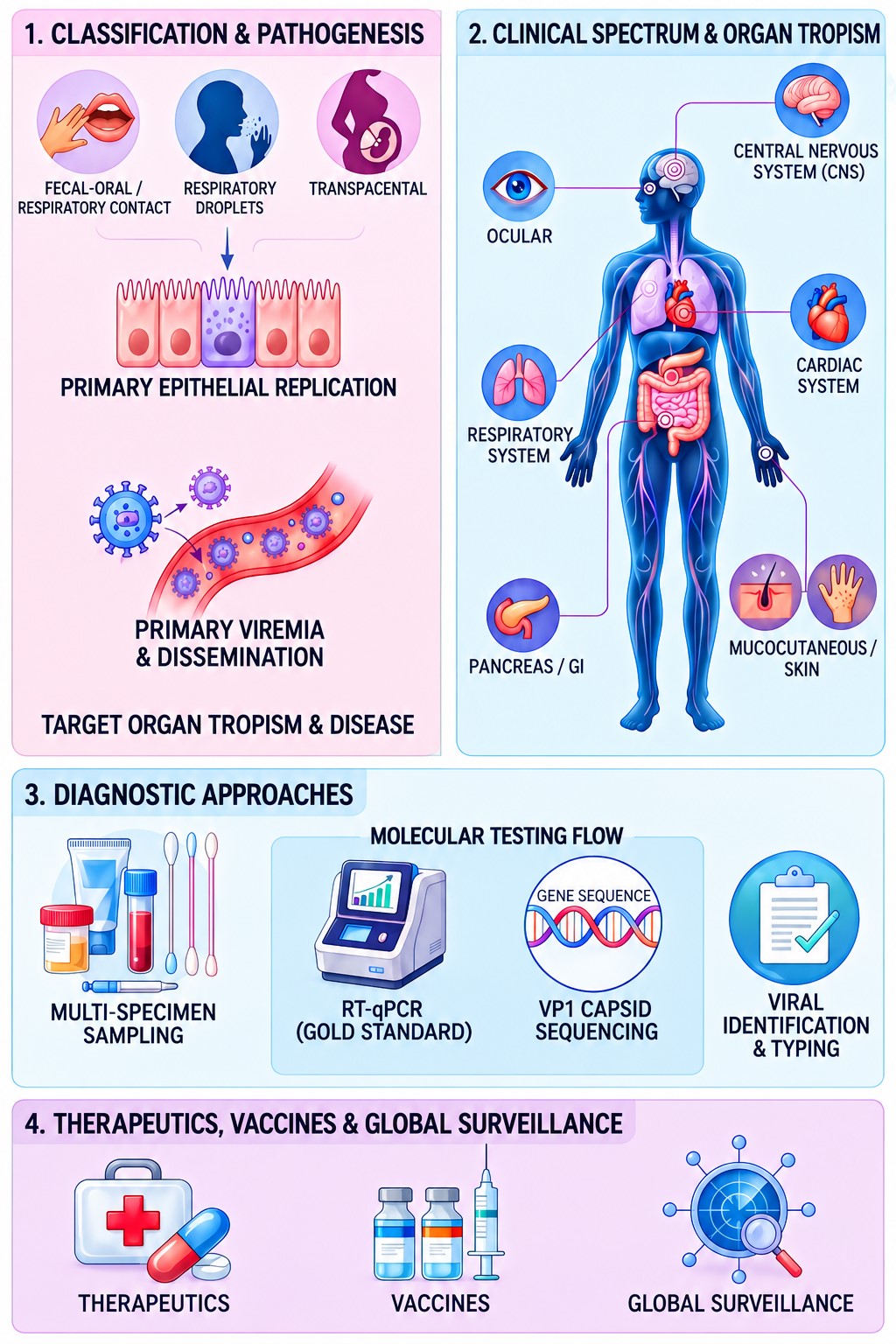
This narrative review highlights recent advances in the understanding of enterovirus infections and the main enterovirus types associated with clinical syndromes, synthesizing current knowledge of type-specific manifestations. We searched PubMed®, Scientific Electronic Library Online (SciELO), and Virtual Health Library (VHL) for articles published between 2010 and 2025. The search used descriptors and/or keywords in Portuguese and English: “enterovirus infection disease”, “enterovirus infection genotypes”, “enterovirus infection pathogenic”, and “enterovirus clinical syndromes”, focusing on recent studies addressing enterovirus infections and the types most commonly associated with clinical syndromes. A total of 78 articles were selected for analysis. The review examined the distribution of enteroviruses by species, recommended clinical specimen types for diagnosis according to clinical presentation, and the major enterovirus types and their associated clinical syndromes. Numerous studies have demonstrated the epidemic potential and genetic diversity of enteroviruses, revealing patterns of endemic circulation. However, the mechanisms underlying the ability of a wide variety of enterovirus types to infect the same tissue remain poorly understood.
References
1. Tapparel C, Siegrist F, Petty TJ, Kaiser L. Picornavirus and enterovirus diversity with associated human diseases. Infect Gent Evol. 2013;14:282-93. https://doi.org/10.1016/j.meegid.2012.10.016
2. Machado RS, Tavares FN, Sousa Jr IP. Global landscape of coxsackieviruses in human health. Virus Res. 2024;344:199367. https://doi.org/10.1016/j.virusres.2024.199367
3. Picornavirus home. Enterovirus. [cited 2023 Nov 23]. Available from: https://www.picornaviridae.com/ensavirinae/enterovirus/enterovirus.htm
4. International Committee on Taxonomy of Viruses – ICTV. Family: Picornaviridae. Genus: Enterovirus. London: ICTV; 2023 [cited 2024 Nov 23]. Available from: https://ictv.global/report/chapter/picornaviridae/picornaviridae/enterovirus
5. Harvala H, Jasir A, Penttinen P, Celentano LP, Greco D, Broberg E. Surveillance and laboratory detection for non-polio enteroviruses in the European Union/European Economic Area, 2016. Euro Surveill. 2017;22(45):16-00807. https://doi.org/10.2807/1560-7917.ES.2017.22.45.16-00807
6. Baggen J, Thibaut HJ, Strating JRPM, van Kuppeveld FJM. The life cycle of non-polio enteroviruses and how to target it. Nat Rev Microbiol. 2018;16(6):368-81. https://doi.org/10.1038/s41579-018-0005-4
7. World Health Organization – WHO. Guidelines for drinking-water quality. Fourth Edition Incorporating the First Addendum. Geneva, Switzerland. 2017; ISBN 978-92-4-154995-0.
8. Xie Z, Khamrin P, Maneekarn N, Kumthip K. Epidemiology of enterovirus genotypes in association with human diseases. Viruses. 2024;16(7):1165. https://doi.org/10.3390/v16071165
9. Vlok M, Majer A. Global prevalence of non-polio enteroviruses pre- and post-COVID-19 pandemic. Microorganisms. 2025;13(8):1801. https://doi.org/10.3390/microorganisms13081801
10. Siddaway AP, Wood AM, Hedges LV. How to do a systematic review: a best practice guide for conducting and reporting narrative reviews, meta-analyses, and meta-syntheses. Annu Rev Psychol. 2019;70:747-70. https://doi.org/10.1146/annurev-psych-010418-102803
11. Crom SCM, Rossen JWA, van Furth AM, Obihara CC. Enterovirus and parechovirus infection in children: a brief overview. Eur J Pediatr. 2016;175(8):1023-9. https://doi.org/10.1007/s00431-016-2725-7
12. Staring J, von Castelmur E, Blomen VA, van den Hengel LG, Brockmann M, Baggen J et al. PLA2G16 represents a switch between entry and clearance of Picornaviridae. Nature. 2017;19;541(7637):412-6. https://doi.org/10.1038/nature21032
13. Muehlenbachs A, Bhatnagar J, Zaki SR. Tissue tropism, pathology and pathogenesis of enterovirus infection. J Pathol. 2015;235(2):217-28. https://doi.org/10.1002/path.4438
14. Sin J, Mangale V, Thienphrapa W, Gottlieb RA, Feuer R. Recent progress in understanding coxsackievirus replication, dissemination, and pathogenesis. Virology. 2015;484:288-304. https://doi.org/10.1016/j.virol.2015.06.006
15. Ho BC, Yang PC, Yu SL. MicroRNA and pathogenesis of enterovirus infection. Viruses. 2016;6;8(1):11. https://doi.org/10.3390/v8010011
16. Zueter ARM, Zaiter A. Infectious meningitis. Clin Microbiol News. 2015;37(6):43-51. https://doi.org/10.1016/j.clinmicnews.2015.02.004
17. Cordey S, Schibler M, L’Huillier AG, Wagner N, Gonçalves AR, Ambrosioni J et al. Comparative analysis of viral shedding in pediatric and adult subjects with central nervous system-associated enterovirus infections from 2013 to 2015 in Switzerland. J Clin Virol. 2017;89:22-9. https://doi.org/10.1016/j.jcv.2017.01.008
18. van der Linden L, Wolthers KC, van Kuppeveld FJM. Replication and inhibitors of enteroviruses and parechoviruses. Viruses. 2015;10;7(8):4529-62. https://doi.org/10.3390/v7082832
19. Carmona RCC, Machado BC, Sousa CA, Vieira HR, Alves MRM, Souza KAF et al. Distribution of species in patients with central nervous system infections in São Paulo State, Brazil. J Med Virol. 2020;92:3849-56. https://doi.org/10.1002/jmv.26131
20. Castillo F, Turón-Viñas E, Armendariz L, Carbonell E, Rabella N, del Cuerpo M et al. Characteristics of enterovirus infection-associated neurologic disease associated in a pediatric population in Spain. Enferm Infecc Microbiol Clin. 2024;42(3):242-50. https://doi.org/10.1016/j.eimc.2023.02.002
21. Li Z, Yang X, Bai R, Li P, Qin Y, Luo M. Circulated echovirus 18 strains in Guangdong Province and worldwide: a novel perspective on genetic diversity and recombination patterns. Virulence. 2025;16(1):2534519. https://doi.org/10.1080/21505594.2025.2534519
22. Jain S, Patel B, Bhatt GC. Enteroviral encephalitis in children: clinical features, pathophysiology, and treatment advances. Pathog Glob Health. 2014;108(5):216-22. https://doi.org/10.1179/2047773214Y.0000000145
23. Costa BK, Sato DK. Viral encephalitis: a practical review on diagnostic approach and treatment. J Pediatr (Rio J). 2020;96(S1):12-9. https://doi.org/10.1016/j.jped.2019.07.006
24. Chen BS, Lee HC, Lee KM, Gong YN, Shih SR. Enterovirus and encephalitis. Front Microbiol. 2020;20;11:261. https://doi.org/10.3389/fmicb.2020.00261
25. Rudolph H, Schroten H, Tenenbaum T. Enterovirus infections of the central nervous system in children: an update. Pediatr Infect Dis J. 2016;35(5):567-9. https://doi.org/10.1097/INF.0000000000001090
26. van Rensburg MJ, Mans J, Mafuyeka RT, Strydom KA, Myburgh M, van Zyl WB. Diversity of enteroviruses in cerebrospinal fluid specimens of patients hospitalized with meningitis and encephalitis in South Africa. J Med Virol. 2024;96(3):e29514. https://doi.org/10.1002/jmv.29514
27. Suresh S, Rawlinson WD, Andrews PI, Stelzer-Braid S. Global epidemiology of nonpolio enteroviruses causing severe neurological complications: a systematic review and meta-analysis. Rev Med Virol. 2020;30(1):e2082. https://doi.org/10.1002/rmv.2082
28. Berginc N, Lunar MM, Šramel N, Poljak M. Molecular epidemiology and characterization of enteroviruses detected in cerebrospinal fluid and respiratory samples in Slovenia, 2014-2023. J Med Virol. 2024;96(7):e29827. https://doi.org/10.1002/jmv.29827
29. Bao J, Thorley B, Isaacs D, Dinsmore N, Elliott EJ, McIntyre P et al. Polio – the old foe and new challenges: an update for clinicians. J Paediatr Child Health. 2020;56(10):1527-32. https://doi.org/10.1111/jpc.15140
30. Böttcher S, Neubauer K, Baillot A, Rieder G, Adam M, Diedrich S. Stool screening of Syrian refugees and asylum seekers in Germany, 2013/2014: identification of Sabin like polioviruses. Int J Med Microbiol. 2015;305(7):601-6. https://doi.org/10.1016/j.ijmm.2015.08.008
31. Waldman EA. Poliomielite e seu controle pela imunização. In: João Baptista Risi Junior. (Org.). Poliomielite no Brasil: do reconhecimento da doença ao fim da transmissão. 1a. ed. Rio de Janeiro: Editora Fiocruz, 2019, v. 1, p. 19-46. https://doi.org/10.7476/9786557080627
32. Suresh S, Forgie S, Robinson J. Non-polio Enterovirus detection with acute flaccid paralysis: a systematic review. J Med Virol. 2018;90(1):3-7. https://doi.org/10.1002/jmv.24933
33. Fischer TK, Simmonds P, Harvala H. The importance of enterovirus surveillance in a post-polio world. Lancet Infect Dis. 2022;22(1):e35-e40. https://doi.org/10.1016/S1473-3099(20)30852-5
34. Carmona RCC, Reis FC, Cilli A, Dias JMM, Machado BC, Morais DR et al. Beyond poliomyelitis: a 21- year study of non-polio enterovirus genotyping and its relevance in acute flaccid paralysis in São Paulo, Brazil. Viruses. 2024;16(12):1875. https://doi.org/10.3390/v16121875
35. Sousa Jr IP, Oliveira MLA, Burlandy FM, Machado RS, Oliveira SS, Tavares FN et al. Molecular characterization and epidemiological aspects of non-polio enteroviruses isolated from acute flaccid paralysis in Brazil: a historical series (2005-2017). Emerg Microbes Infect. 2020;9(1):2536-46. https://doi.org/10.1080/22221751.2020.1850181
36. Cong R, Xiao J, Ji T, Sun Q, Lu H, Yang D et al. Genetic characterization and molecular epidemiological analysis of enterovirus C99 in China. J Med Virol. 2024;96(2):e29449. https://doi.org/10.1002/jmv.29449
37. Fernandez-Garcia MD, Garcia-Ibañez N, Camacho J, Gutierrez A, Garcia LS, Calvo C et al. Enhanced echovirus 11 genomic surveillance in neonatal infections in Spain following a European alert reveals new recombinant forms linked to severe cases, 2019 to 2023. Euro Surveill. 2024;29(44):2400221. https://doi.org/10.2807/1560-7917.ES.2024.29.44.2400221
38. Schultheiss HP, Kühl U, Cooper LT. The management of myocarditis. Eur Heart J. 2011;32(21):2616-25. https://doi.org/10.1093/eurheartj/ehr165
39. Sinnecker D, Laugwitz KL, Moretti A. Extending human induced pluripotent stem cell technology to infectious diseases: new model for viral myocarditis. Circ Res. 2014;29;115(6):537-9. https://doi.org/10.1161/CIRCRESAHA.114.304786
40. Persichino J, Garrison R, Krishnan R, Sutjita M. Effusive-constrictive pericarditis, hepatitis, and pancreatitis in a patient with possible coxsackievirus B infection: a case report. BMC Infect Dis. 2016;8;16:375. https://doi.org/10.1186/s12879-016-1752-3
41. Medina NH, Haro-Muñoz E, Pellini AC, Machado BC, Russo DH, Timenetsky MD et al. Acute hemorrhagic conjunctivitis epidemic in São Paulo State, Brazil, 2011. Rev Panam Salud Publica. 2016;39(2):137-41. Available from: https://www.scielosp.org/article/rpsp/2016.v39n2/137-141/
42. Zhang L, Zhao N, Huang X, Jin X, Geng X, Chan TC et al. Molecular epidemiology of acute hemorrhagic conjunctivitis caused by coxsackie A type 24 variant in China, 2004-2014. Sci Rep. 2017;23;7:45202. https://doi.org/10.1038/srep45202
43. Chen L, Yang H, Zhang HL, Shi XL, Peng B, Meng J. Pathogen surveillance of acute conjunctivitis reveals recent emergence of coxsackievirus A24 variants and high genotypic diversity of human adenoviruses in Shenzhen, China, 2018-2024. J Clin Virol. 2025;180:105852. https://doi.org/10.1016/j.jcv.2025.105852
44. Haider SA, Jamal Z, Ammar M, Hakim R, Afrough B, Kreku A et al. Genomic characterization of the Coxsackievirus A24 variant in the acute hemorrhagic conjunctivitis outbreak (2023) in Islamabad, Pakistan through metagenomic next generation sequencing. J Virol Methods. 2025;338:115213. https://doi.org/10.1016/j.jviromet.2025.115213
45. Gyeltshen S, Dorji T, Dorji K, Wangchuk S, Tshering D, Poolpanichupatam Y et al. Coxsackievirus A24 variant associated with acute hemorrhagic conjunctivitis outbreak in Bhutan, 2023. Sci Rep. 2025;15(1):14864. https://doi.org/10.1038/s41598-025-94776-7
46. Hosoya M, Ishiko H, Shimada Y, Honzumi K, Suzuki S, Kato K et al. Diagnosis of group A coxsackieviral infection using polymerase chain reaction. Arch Dis Child. 2002;87(4):316-9. https://doi.org/10.1136/adc.87.4.316
47. Lee CJ, Huang YC, Yang S, Tsao KC, Chen CJ, Hsieh YC et al. Clinical features of coxsackievirus A4, B3 and B4 infections in children. PLoS One. 2014;9(2):e87391. https://doi.org/10.1371/journal.pone.0087391
48. Li ML, Shih SR, Tolbert BS, Brewer G. Enterovirus A71 vaccines. Vaccines. 2021;9(3):199. https://doi.org/10.3390/vaccines9030199
49. Lv T, Li Y, Yu P, Chen X, Li H, Zhang N et al. Genome analysis of coxsackievirus A4 identified from herpangina children in Northern China. Curr Microbiol. 2025;82(2):81. https://doi.org/10.1007/s00284-025-04075-7
50. Itani TM, Chalapa VI, Slautin VN, Imangaliev BS, Kungurtseva MS, Patrusheva AK et al. Circulation of non-polio enteroviruses in the Ural Federal District and Western Siberia in 2023: the return of an old foe? Arch Virol. 2025;170(5):110. https://doi.org/10.1007/s00705-025-06284-8
51. Xing B, Hu L, Hu X, Sun Y, Liang Z, Fu J et al. Epidemiological, clinical, and molecular characteristics of coxsackievirus A2 infections during a herpangina outbreak in children on an Island in Eastern China in 2024: a surveillance-based study. Gut Pathog. 2025;17(1):85. https://doi.org/10.1186/s13099-025-00762-9
52. Gong J, Liu S, Liu S, Sun R, Xiao S, Su Z et al. Genetic characterization of human enterovirus A71 genotypes C4 and B5 circulating in Qingdao City, Shandong province, China, from 2023 to 2024. Front Cell Infect Microbiol. 2025;15:1684067. https://doi.org/10.3389/fcimb.2025.1684067
53. Chang YK, Chen KH, Chen KT. Hand, foot and mouth disease and herpangina caused by enterovirus A71 infections: a review of enterovirus A71 molecular epidemiology, pathogenesis, and current vaccine development. Rev Inst Med Trop São Paulo. 2018;60:e70. https://doi.org/10.1590/S1678-9946201860070
54. Sousa Jr IP, Burlandy FM, Tavares FN, Silva EE. Enterovirus B74 associated with hand, foot and mouth disease. Infect Genet Evol. 2018;65:15-7. https://doi.org/10.1016/j.meegid.2018.07.011
55. Carmona RCC, Machado BC, Reis FC, Jorge AMV, Cilli A, Dias AMN et al. Hand, foot, and mouth disease outbreak by Coxsackievirus A6 during COVID-19 pandemic in 2021, São Paulo, Brazil. J Clin Virol. 2022;154:105245. https://doi.org/10.1016/j.jcv.2022.105245
56. Rueca M, Vairo F, Spaziante M, Fabeni L, Forbici F, Berno G et al. Molecular genotyping of circulating enterovirus in the Lazio Region from 2012 to 2023. Viruses. 2024;16(7):1013. https://doi.org/10.3390/v16071013
57. Asowata OE, McMillen T, Jani K, Clark B, Morjaria S, Kamboj M et al. Prevalence and epidemiology of enterovirus species in a pediatric oncology patient population. J Clin Virol. 2025;178:105881. https://doi.org/10.1016/j.jcv.2025.105881
58. Lal A, Akhtar J, Isaac S, Mishra AK, Khan MS, Noreldin M et al. Unusual cause of chest pain, Bornholm disease, a forgotten entity; case report and review of literature. Respir Med Case Rep. 2018;25:270-3. https://doi.org/10.1016/j.rmcr.2018.10.005
59. Rodriguez-Calvo T. Enterovirus infection and type 1 diabetes: unraveling the crime scene. Clin Exp Immunol. 2019;195(1):15-24. https://doi.org/10.1111/cei.13223
60. Nyalwidhe JO, Gallagher GR, Glenn LM, Morris MA, Vangala P, Jurczyk A et al. Coxsackievirusinduced proteomic alterations in primary human islets provide insights for the etiology of diabetes. J Endocr Soc. 2017;1(10):1272-86. https://doi.org/10.1210/js.2017-00278
61. Yeung WCG, Rawlinson WD, Craig ME. Enterovirus infection and type 1 diabetes mellitus: systematic review and meta-analysis of observational molecular studies. BMJ. 2011;342:d35. https://doi.org/10.1136/bmj.d35
62. Gosert R, Heininger U, Hirsch HH. Enterovirus detection in patients with acute gastroenteritis in Switzerland. J Med Virol. 2018;90(4):685-91. https://doi.org/10.1002/jmv.25005
63. Canela LNP, Magalhães-Barbosa MC, Raymundo CE, Carney S, Siqueira MM, Prata-Barbosa A et al. Viral detection profile in children with severe acute respiratory infection. Braz J Infect Dis. 2018;22(5):402-11. https://doi.org/10.1016/j.bjid.2018.09.001
64. Elrick MJ, Pekosz A, Duggal P. Enterovirus D68 molecular and cellular biology and pathogenesis. J Biol Chem. 2021;296:100317. https://doi.org/10.1016/j.jbc.2021.100317
65. Piralla A, Principi N, Ruggiero L, Girello A, Giardina F, Sando E et al. Enterovirus-D68 (EV-D68) in pediatric patients with respiratory infection: The circulation of a new B3 clade in Italy. J Clin Virol. 2018;99-100:91-6. https://doi.org/10.1016/j.jcv.2018.01.005
66. Holm-Hansen CC, Midgley SE, Fischer TK. Global emergence of enterovirus D68: a systematic review. Lancet Infect Dis. 2016;16(5):e64-e75. https://doi.org/10.1016/S1473-3099(15)00543-5
67. Raboni SM, Giamberardino HI, Debur MC, Santos JS. Enterovirus D68-associated respiratory infection in southern Brazil, 2018 – A population-based laboratory surveillance. J Clin Virol. 2020;129:104503. https://doi.org/10.1016/j.jcv.2020.104503
68. Ikuse T, Aizawa Y, Kachikawa R, Kamata K, Osada H, Win SMK et al. Detection of enterovirus D68 among children with severe acute respiratory infection in Myanmar. J Microbiol Immunol Infect. 2024;57(2):123-30. https://doi.org/10.1016/j.jmii.2024.01.001
69. Lima ARJ, Santos HO, Pereira JS, Leite AB, Nascimento JPM, Souza JVC et al. Enterovirus D68 subgenotype B3 circulation in Children with acute respiratory illness in the State of Alagoas, Brazil. Viruses. 2025;17(2):242. https://doi.org/10.3390/v17020242
70. Fall A, Zhuang TX, Dodge A, Abdullah O, Norton JM, Villafuerte D et al. Molecular characterization of emerging and uncommon enteroviruses C104, C105, and C109 in respiratory samples from Maryland, USA, 2018-2024. Viruses. 2025;17(9):1183. https://doi.org/10.3390/v17091183
71. Fernandez-Garcia MD, Camacho J, Diez-Fuertes F, Pedro ER, Garcia-Ibañez N, Navascués A et al. Detections of rare enterovirus C105 linked to an emerging novel clade, Spain, 2019 to 2024. Euro Surveill. 2025;30(6):2500073. https://doi.org/10.2807/1560-7917.ES.2025.30.6.2500073
72. Menegolla IA, Martins LG, Patzer JD, Calderaro PC, Peres CCMC, Fay VS et al. Enteroviroses no Rio Grande do Sul: uma vigilância a ser estruturada? Bol Epidemiológico. 2016;18(3):1-3.
73. Qiu X, Cao F, Cheng S, Li J. Molecular epidemiology, coinfection, and diversity of enteroviruses detected in respiratory samples collected from patients with influenza-like illness in Hangzhou, China, in 2023. Virol J. 2025;22:227. https://doi.org/10.1186/s12985-025-02862-z
74. Harvala H, Broberg E, Benschop K, Berginc N, Ladhani S, Susi P et al. Recommendations for enterovirus diagnostics and characterisation within and beyond Europe. J Clin Virol. 2018;101:11-7. https://doi.org/10.1016/j.jcv.2018.01.00
75. World Health Organization – WHO. Polio laboratory manual 4th edition. Geneva 27, Switzerland: Department of Immunization, Vaccines and Biologicals CH-1211. 2004. pp. 1-167. Available from: https://iris.who.int/server/api/core/bitstreams/4f3de082-d394-45ed-81f5-ea1f001991f1/content
76. Nix WA, Oberste MS, Pallansch MA. Sensitive, seminested PCR amplification of VP1 sequences for direct identification of all enterovirus serotypes from original clinical specimens. J Clin Microbiol. 2006;44(8):2698-704. https://doi.org/10.1128/JCM.00542-06
77. Baicus A. History of polio vaccination. World J Virol. 2012;1(4):108-14. https://doi.org/10.5501/wjv.v1.i4.108
78. Jubelt B, Lipton HL. Chapter 18 – Enterovirus/picornavirus infections. Handb Clin Neurol. 2014; 123:379-416. https://doi.org/10.1016/B978-0-444-53488-0.00018-3
79. Abzug MJ. The enteroviruses: problems in need of treatments. J Infect. 2014;68(1):S108-S14. https://doi.org/10.1016/j.jinf.2013.09.020
80. Lin JY, Kung YA, Shih SR. Antivirals and vaccines for Enterovirus A71. J Biomed Sci. 2019;26:65. https://doi.org/10.1186/s12929-019-0560-7

This work is licensed under a Creative Commons Attribution 4.0 International License.
Copyright (c) 2026 Fabrício Caldeira Reis, Alex Domingos Reis, Bráulio Caetano Machado, Rita de Cássia Compagnoli Carmona