Palabras clave
Health Personnel
Emergency Medical Services
Emergency Responders
Cómo citar
Resumen
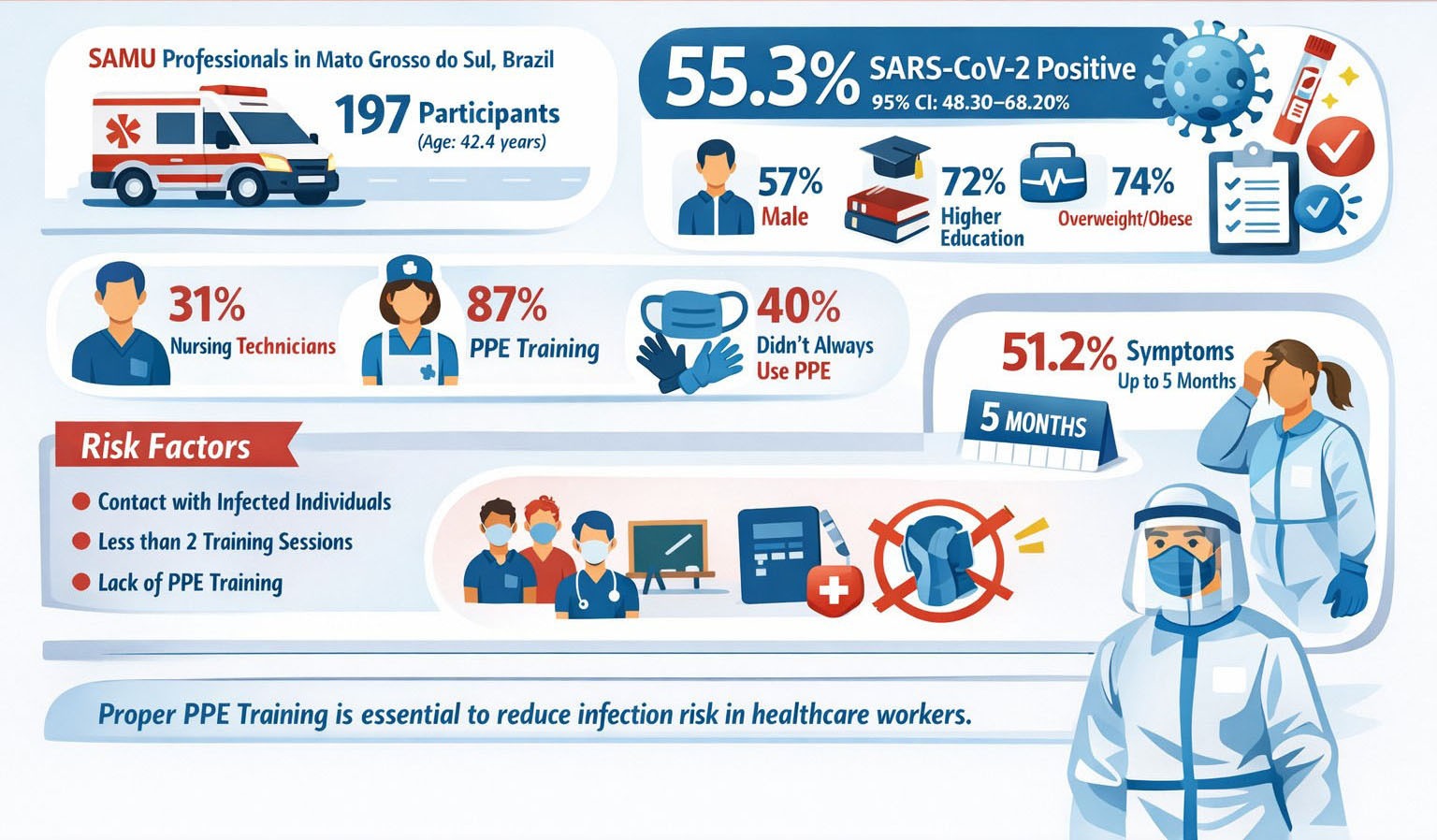
This study aimed to assess the prevalence, predictive factors, and post-COVID-19 symptoms of SARS-CoV-2 infection among Mobile Emergency Medical Service (SAMU) professionals in Mato Grosso do Sul, Brazil. A cross-sectional design was used, based on primary quantitative data. SARS-CoV-2 infection was defined based on self-reported information indicating at least one positive real-time reverse transcription quantitative polymerase chain reaction (RT-qPCR) or rapid antigen/protein test result. Among 197 participants (mean age 42.4 years), 57.0% were male and 72.0% had higher education. Most were overweight/obese (74.0%), and 22.0% reported previous comorbidities. Nursing technicians represented 31.0% of the sample. Although 87.0% received training on personal protective equipment (PPE) use, 40.0% admitted to not using it at some point. A high prevalence of SARS-CoV-2 infection was found (55.3%; 95.0% CI: 48.30-68.20). Multivariate analysis showed that infection was associated with prior contact with infected individuals, fewer than two training sessions, and lack of training on proper PPE use. Additionally, 51.2% reported persistent symptoms lasting up to five months after infection. These findings indicate that SAMU professionals face a high risk of SARS-CoV-2 exposure. Proper PPE training is essential to reduce infection risk in healthcare workers.
Citas
1. World Health Organization – WHO. Guideline Clinical management of COVID-19: living guideline. 6th ed. Geneva: World Health Organization; 2023 [cited 2023 May 18]. 181 p. Available from: https://iris.who.int/items/f09974e2-6561-475d-bb2e-b38765fa93c1
2. McEllistrem MC, Clancy CJ, Buehrle DJ, Singh N, Lucas A, Sirianni V et al. SARS-CoV-2 is associated with high viral loads in asymptomatic and recently symptomatic healthcare workers. PLoS One. 2021;16(3):e0248347. https://doi.org/10.1371/journal.pone.0248347
3. Dal Pai D, Gemelli MP, Boufleuer E, Finckler PVPR, Miorin JD, Tavares JP et al. Repercussions of the COVID-19 pandemic on the emergency pre-hospital care service and worker’s health. Esc Anna Nery. 2021;25(spe):e20210014. https://doi.org/10.1590/2177-9465-EAN-2021-0014
4. Dzinamarira T, Murewanhema G, Mhango M, Iradukunda PG, Chitungo I, Mashora M et al. COVID-19 prevalence among healthcare workers. A systematic review and meta-analysis. Int J Environ Res Public Health. 2021;19(1):146. https://doi.org/10.3390/ijerph19010146
5. Leite SN, Finkler M, Martini JG, Heidemann I, Verdi M, Hellmann F et al. Management of the health workforce in facing COVID-19: disinformation and absences in Brazil’s public policies. Ciên Saúde Colet. 2021;26(5):1873-84. https://doi.org/10.1590/1413-81232021265.01252021
6. Ministério da Saúde (BR). Gabinete do Ministro. Portaria n° 2.048, de 05 de novembro de 2002. Aprova, na forma do Anexo desta Portaria, o regulamento técnico dos sistemas estaduais de urgência e emergência. Diário Oficial da União. Brasília, DF, 12 nov 2002. Seção 1(219):32-54.
7. Brasil. Ministério da Saúde. Manual de regulação médica das urgências. Brasília; 2006; 126p. Disponível em: https://www.gov.br/saude/pt-br/composicao/saes/samu-192/publicacoes/regulacao_medica_urgencias.pdf/view
8. Lai CC, Shih TP, Ko WC, Tang HJ, Hsueh PR. Severe acute respiratory syndrome SARS-CoV-2 (SARSCoV-2) and coronavirus disease-2019 (COVID-19): the epidemic and the challenges. Int J Antimicrob Agents. 2020;55(3):105924. https://doi.org/10.1016/j.ijantimicag.2020.105924
9. Rodrigues KF, Carpes MM, Raffagnato CG. Preparação e resposta a desastres do Brasil na pandemia da COVID-19. Rev Adm Pública. 2020;54(4):614-34. https://doi.org/10.1590/0034-761220200291
10. Esperidião E, Saidel MGB, Rodrigues J. Saúde mental: foco nos profissionais de saúde. Rev Bras Enferm. 2020;73(Suppl 1):e73supl01. https://doi.org/10.1590/0034-7167.202073supl01
11. Saidel MGB, Lima MHM, Campos CJG, Loyola CMD, Espiridião E, Rodrigues J. Intervenções em saúde mental para profissionais de saúde frente à pandemia de coronavírus. Rev Enferm UERJ. 2020;28:e49923. https://doi.org/10.12957/reuerj.2020.49923
12. Tarabichi Y, Watts B, Collins T, Margolius D, Avery A, Gunzler D et al. SARS-CoV-2 Infection among serially tested emergency medical services workers. Prehosp Emerg Care. 2021;25(1):39-45. https://doi.org/10.1080/10903127.2020.1831668
13. Nguyen LH, Drew DA, Graham MS, Joshi AD, Guo CG, Ma W et al. Risk of COVID-19 among frontline health-care workers and the general community: a prospective cohort study. Lancet Public Health. 2020;5(9):e475-83. https://doi.org/10.1016/S2468-2667(20)30164-X
14. Ganz-Lord FA, Segal KR, Rinke ML. COVID-19 symptoms, duration, and prevalence among healthcare workers in the New York metropolitan area. Infect Control Hosp Epidemiol. 2021;42(8):917-23. https://doi.org/10.1017/ice.2020.1334
15. Antonio-Villa NE, Bello-Chavolla OY, Vargas-Vázquez A, Fermín-Martínez CA, Márquez-Salinas A, Pisanty-Alatorre J et al. Assessing the burden of coronavirus disease 2019 (COVID-19) among healthcare workers in Mexico City: a data-driven call to action. Clin Infect Dis. 2021;73(1):e191-8. https://doi.org/10.1093/cid/ciaa1487
16. Buonafine CP, Paiatto BNM, Leal FB, Matos SF, Morais CO, Guerra GG et al. High prevalence of SARSCoV-2 infection among symptomatic healthcare workers in a large university tertiary hospital in São Paulo, Brazil. BMC Infect Dis. 2020;20:917. https://doi.org/10.1186/s12879-020-05662-8
17. Albuquerque MFPM, Souza WV, Montarroyos UR, Pereira CR, Braga C, Araújo TVB et al. Risk of SARS-CoV-2 infection among front line healthcare workers in Northeast Brazil: a respondent-driven sampling approach. BMJ Open. 2022;12:e058369. https://doi.org/10.1136/bmjopen-2021-058369
18. Gasparoto ALDB. Infecção por SARS-CoV-2 em profissionais de saúde em hospitais terciários de Campo Grande – MS [dissertação de mestrado]. Campo Grande (MS): Universidade Federal de Mato Grosso do Sul; 2022. Available from: https://repositorio.ufms.br/handle/123456789/5077
19. Mostafa A, Kandil S, El-Sayed MH, Girgis S, Hafez H, Yosef M et al. Universal COVID-19 screening of 4040 health care workers in a resource-limited setting: an Egyptian pilot model in a university with 12 public hospitals and medical centers. Int J Epidemiol. 2021;50(1):50-61. https://doi.org/10.1093/ije/dyaa173
20. Shah ASV, Wood R, Gribben C, Caldwell D, Bishop J, Weir A et al. Risk of hospital admission with coronavirus disease 2019 in healthcare workers and their households: nationwide linkage cohort study. BMJ. 2020;371:m3582. https://doi.org/10.1136/bmj.m3582
21. Nafisah SAB, Mzahim BY, Aleid BS, Sheerah SA, Almatrafi DQ, Ciottone GR et al. The risk of coronavirus to healthcare providers during aerosol-generating procedures: a systematic review and meta-analysis. Ann Thorac Med. 2021;16(2):165-71. https://doi.org/10.4103/atm.ATM_497_20
22. Cash RE, Rivard MK, Camargo Jr CA, Powell JR, Panchal AR. Emergency medical services personnel awareness and training about personal protective equipment during the COVID-19 pandemic. Prehosp Emerg Care. 2021;25(6):777-84. https://doi.org/10.1080/10903127.2020.1853858
23. Martin-Delgado J, Viteri E, Mula A, Serpa P, Pacheco G, Prada D et al. Availability of personal protective equipment and diagnostic and treatment facilities for healthcare workers involved in COVID-19 care: a cross-sectional study in Brazil, Colombia, and Ecuador. PLoS One. 2020;15(11):e0242185. https://doi.org/10.1371/journal.pone.0242185

Esta obra está bajo una licencia internacional Creative Commons Atribución 4.0.
Derechos de autor 2026 Marcela Aparecida Bertoldi de Melo, Viviane Torqueti Felisberto Souza , Carolina Amianti, Larissa Melo Bandeira , Sandra Maria do Vale Leone de Oliveira, Ana Rita Coimbra Motta-Castro