Submission Preparation Checklist
As part of the submission process, authors are required to check off their submission's compliance with all of the following items, and submissions may be returned to authors that do not adhere to these guidelines.- The contribution is original and unpublished, and is not being evaluated for publication by another journal or will it is while its publication is being considered by the Adolfo Lutz Institute Journal. This item does not apply to documents that have been deposited in preprint repositories.
- A mandatory Cover Letter, as indicated in the Requested Documents section of the Author Guidelines, must be signed by all authors.
- Presentation Form, a mandatory document, must be prepared as indicated in the Requested Documents section of the Author Guidelines.
- The manuscript must be formatted using Microsoft Word, in an editable format, configured for A4 paper, Times New Roman font, size 12, double spacing for the text, and single spacing for references, justified text, and left alignment for references.
- Tables must be numbered sequentially and presented in a separate document from the manuscript, indicating where they should be inserted in the text, formatted using Microsoft Word, in an editable format, configured in Times New Roman font, size 10, containing a maximum of 12 columns and notes in Times New Roman font, size 9.
- Figures must be in tif, jpeg, or pdf format, with a minimum resolution of 300 dpi, attached in a separate document, indicating where they should be inserted in the text.
- Citations and references must follow the instructions and models presented in the Vancouver style, providing URLs or DOIs when available.
- Authors must indicate the Research Organization Registry - ROR of the institution to which they are affiliated, inserting the name of the institution and selecting the corresponding ROR ID in the submission form. The ROR is a unique and open identifier developed to eliminate ambiguities in institutional names and connect research organizations, researchers, and research outcomes.
- Authors must provide their ORCID (Open Researcher and Contributor), registration number, a widely accepted and recognized unique digital identifier among researchers and academics.
- Authors should provide the email address linked to their Lattes curriculum, when possible.
- When applicable, authors must inform about related funding, indicating the name of the funding agency and the process number(s). In cases of articles related to theses/dissertations, they must indicate the name of the institution/program, degree, and year of defense.
Author Guidelines
These guidelines aim to assist authors in preparing and submitting manuscripts to the Adolfo Lutz Institute Journal. Only manuscripts that are strictly compliant with these guidelines will be submitted to the editorial process.
The Adolfo Lutz Institute Journal (RIAL) accepts the publication of original works in all laboratory areas of public health, in the categories: review articles, original articles, brief communications, scientific notes, technical-scientific comments, and case reports.
Manuscripts must be exclusively submitted to RIAL, and simultaneous submission to another journal is not permitted. Contributions may be presented in Portuguese, English, or Spanish.
RIAL does not charge any fees for the submission, evaluation, and publication of articles, and the entire process is free of charge for authors.
The Journal is registered with Crossref and assigns a unique persistent identifier - Digital Object Identifier (DOI) - to all published articles.
With online publication via the OJS platform, RIAL has adopted the Creative Commons Attribution 4.0 International License for the published content. Therefore, a Copyright Transfer Agreement will NOT be required after the manuscript is approved for publication.
Original manuscripts received will undergo a two-stage analysis: a preliminary evaluation conducted by the RIAL editorial committee, followed by a peer review using a double-blind system with specialists in the area of study. For more information on RIAL's evaluation process, see Peer Review.
To ensure the application of the double-blind peer review system, manuscripts must be prepared by authors in a way that does not reveal their identity; thus, it is necessary to remove authors' names and affiliations from the manuscript. This information should only be included on the Presentation Form.
Requested Documents
In accordance with the guidelines of the International Committee of Medical Journal Editors, some documents and statements from the author(s) are required for the evaluation of their manuscript. Please see the list of documents below and, where applicable, attach the document to the process.
- Presentation Form (mandatory document)
- Cover Letter (mandatory document)
- Open Science Compliance Form
- Manuscript (mandatory document)
- Approval from the Research Ethics Committee — if applicable
Accepted Categories in RIAL
- Review Article: Dedicated to presenting and discussing themes of scientific interest and relevance to public health. They must clearly formulate a scientific object of interest, logical argumentation, theoretical-methodological critique of the consulted works, and a conclusive synthesis.
- Original Article: Study related to the prevention and control of health issues and health promotion. They must be based on original data and perspectives relevant to public health. Each article must contain clear objectives and hypotheses, design and methods used, results, discussion, and conclusions.
- Short Communication: Contribution of importance in the field of public health research, but which does not warrant a more comprehensive analysis due to its complexity and extent. This category will also consider descriptions of new methods or techniques that bring advances to the field of knowledge.
- Scientific Note: Corresponds to a succinct report intended for the rapid dissemination of relevant results, with recognized impact for the scientific community, justifying the publication of partial results at the discretion of the editorial board.
- Technical-Scientific Comment: Contribution of interest in public health intended to disseminate discussed and commented scientific and technological information from the authors' perspective, which can be individual or institutional.
- Case Report: Corresponds to a text that mainly covers medical and veterinary areas, where the result is prior to the interest of its dissemination or the occurrence of the results is not planned.
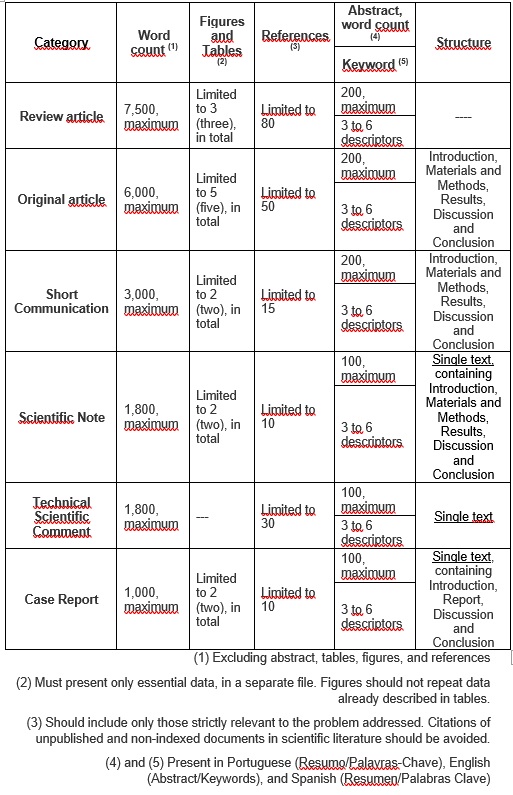
Manuscript Preparation
RIAL accepts manuscripts in Portuguese, English, or Spanish.
The manuscript must be formatted using Microsoft Word, in an editable format, configured for A4 paper, Times New Roman font, size 12, double spacing. Tables and figures must use Times New Roman font, size 10, and footnotes, Times New Roman font, size 9.
Compressed files (zip) should be avoided.
Title of the manuscript: full title in Portuguese, English, and Spanish. It should be concise, clear, and contain information that expresses the content of the manuscript. It should be written in Times New Roman font, size 14 with the first letter of the sentence capitalized and containing up to 180 characters (including spaces).
Section of RIAL to which the manuscript belongs: the author must inform which category the text to be submitted belongs to.
Abstract: Should be written in a single paragraph, with single spacing, without the use of abbreviations or bibliographic citations and structured to include introduction, study objective, methods used, results obtained, discussion of results, and conclusion. It must be presented in Portuguese (Resumo), English (Abstract), and Spanish (Resumen).
Keywords: must indicate a minimum of three (3) and a maximum of six (6) content descriptors extracted from Health Sciences Descriptors (DeCS) or Medical Subject Headings (MESH). They should appear below the abstract text, presented in mixed case and separated by a period. Keywords must also be presented in English (Keywords) and Spanish (Palabras clave), following the respective abstracts.
If suitable descriptors for the manuscript's theme are not found, terms not existing in the mentioned sets may be indicated, limited to one-third of the total descriptors.
Introduction: clear, objective, containing information that contextualizes and justifies the work, restricting references to those pertinent to the field of investigation.
Materials and Methods: concise description, without omitting essential information for understanding and reproducing the work. It should describe the population and sample, measurement instruments, with the presentation, if possible, of validity measures and contain information about data collection and processing. Established methods and techniques must be referenced by citation whenever applicable, including the statistical methods used. New or substantially modified methods must be described, justifying the reasons for their use and mentioning their limitations.
Note: Ethical Committees that evaluated the process of human studies or the norms followed for the protection and experimental treatment of animals must be indicated. This item should contain, when applicable, the subject of the research, the study design, specific procedures, data analysis, and ethical aspects and indicate the name of the ethics committee, number, and date of registration.
Results: should be presented in a logical sequence and, whenever necessary, the results should be accompanied by tables, figures, or other self-explanatory illustrations, restricted to those necessary for argumentation and that should not be described again in text form. The data must undergo statistical analysis whenever applicable. The content should be informative, not interpretive.
Discussion: limited to the results obtained and contain only the necessary references. The content should be interpretative and hypotheses and speculations formulated based on the findings. The text must be argumentative, where authors validate their conclusions. Arguments and evidence based on personal communication or disclosed in restricted documents cannot support the authors' arguments. Both the limitations of the work and its implications for future research must be clarified. Include only hypotheses and generalizations based on the data of the work.
Conclusions: present relevant conclusions, essentially answering the work's objective(s). They may be presented in a separate item or at the end of the Discussion item.
Figures and Tables: Must respect the quantity defined for each category of articles accepted by RIAL. All graphical or tabular elements presented will be identified as figures or tables, and not as boxes, graphs, etc. Figures and tables will be numbered separately, sequentially from 1.
Tables: Must be typed in a Word processor or compatible and presented in separate files, numbered consecutively with Arabic numerals, in the order they were cited in the text. Each must be given a brief title, avoiding internal horizontal or vertical lines. Explanatory notes must be limited to the smallest number possible and placed in the footer of the tables, typed with Times New Roman font size 9. If a table is extracted from another previously published work, authors must formally request permission from the publishing journal for reproduction. Indicate the insertions of the tables in the structure of the text.
Figures: Illustrations (photographs, drawings, graphs, etc.) must be cited as Figures, presented in separate files and numbered consecutively with Arabic numerals in the order they were cited in the text. They must contain title and caption presented at the bottom of the figure. Only figures sufficiently clear and with digital quality, in jpeg or tif format, with a minimum resolution of 300 dpi will be accepted for publication. Figures in pdf will only be accepted in high resolution (300 dpi). If a figure is extracted from another previously published work, authors must request permission in writing for its reproduction. Indicate the insertions of the tables in the structure of the text.
In-Text Citation
The identification of citations in the text and illustrations should be done by superscript Arabic numerals without parentheses, in the order of entry in the text corresponding to the respective order number in the reference list.
In the case of sequential citations, separate the numbers by a dash, or when intercalated numbers use a comma. Example: 1-5 or 1,5,7.
For authors referred to nominally in the text, the reference number should be placed in the sequence of the author's name. Example: (...) obtained by gas chromatography with flame ionization detection (GC/FID)2,3.
For citations of references with two or more authors, the citation should come at the end. Example: Aued-Pimentel and Zenebon20 or according to Chang et al31.
References
Only references cited should be listed at the end of the text, respecting the quantity defined for each category of articles accepted by RIAL, written according to the norms established in Uniform Requirements for Manuscripts Submitted to Biomedical Journals: Writing and Editing for Biomedical Publication, numbered consecutively in the order they were first mentioned in the text and aligned to the left.
Documents with up to six authors should list all surnames and the abbreviated first name, separated by commas. Example: Aued-Pimentel S, Zenebon O.
Documents with more than six authors should list the first six followed by the Latin expression “et al,” separated by commas.
Documentos de um mesmo autor, devem ser devem ser organizadas em ordem cronológica crescente.
Documents by the same author should be organized in chronological ascending order.
Journal titles should be referred to according to the official abbreviation of the journal. For national journals, consult the Portal of Scientific Journals in Health of BVS and for international journals, consult NLM Catalog: journals referenced in the NCBI Databases. If the journal has no abbreviation, use the full name.
In all references, whenever possible, include the direct access link to the cited document and/or the Digital Object Identifier (DOI), which is the last element presented in the reference.
Examples of References
Journal Articles:
Aued-Pimentel S, Zenebon O. Lipídios totais e ácidos graxos na informação nutricional do rótulo dos alimentos embalados: aspectos sobre legislação e quantificação. Rev Inst Adolfo Lutz. 2009;68(2):167-81. https://doi.org/10.53393/rial.2009.v68.32714
Conde MB, Melo FAF, Marques AMC, Cardoso NC, Pinheiro VGF, Dalcin PTR et al. III Diretrizes para tuberculose da Sociedade Brasileira de Pneumologia e Tisiologia. J Bras Pneumol. 2009;35(10):1018-48. https://doi.org/10.1590/S1806-37132009001000011
Lindsay RP, Shin SS, Garfein RS, Rusch MLA, Novotny TE. The association between active and passive smoking and latent tuberculosis infection in adults and children in the United States: results from NHANES. PLoS One. 2014;9(3):e93137. https://doi.org/10.1371/journal.pone.0093137
Hennington EA. Acolhimento como prática interdisciplinar num programa de extensão. Cad Saude Coletiva. 2005;21(1):256-65. https://doi.org/10.1590/S0102-311X2005000100028
Books:
Ringsven MK, Bond D. Gerontology and leadership skills for nurses. 2.ed. Albany (NY): Delmar Publishers;1996.
Lopez D, organizador. Estudos epidemiológicos qualitativos. São Paulo: James Martim; 2009.
Institute of Medicine (US). Looking at the future of the Medicaid program. Washington (DC): The Institute; 1992.
Foley KM, Gelband H, editors. Improving palliative care for cancer. Washington: National Academy Press; 2001[acesso 2003 Jul 13]. Disponível em: http://www.nap.edu/catalog.php?record_id=10149
Book Chapters:
Wirdh L. História da Epidemiologia. In: Lopez D, organizador. Estudos epidemiológicos qualitativos. São Paulo: James Martim; 2009.p.64-76.
Theses, Dissertations, and Monographs:
Santos EP. Estabilidade química da manteiga da terra [dissertação de mestrado]. Bananeiras (PB): Universidade Federal da Paraíba;1995.
Moreschi ECP. Desenvolvimento e validação de métodos cromatográficos e avaliação da estabilidade de vitaminas hidrossolúveis em alimentos [tese de doutorado]. São Paulo (SP): Universidade de São Paulo; 2006.
Conference Papers, Symposia, Meetings, Seminars, and Others:
Colombo FA, Vidal JE, Oliveira ACP, Focaccia R, Pereira-Chioccola VL. O uso de métodos moleculares na avaliação do diagnóstico da toxoplasmose cerebral em pacientes com AIDS. III Encontro do Programa de Pós-Graduação em Infecções e Saúde Pública; agosto de 2004; São Paulo: Rev Inst Adolfo Lutz. p. 30 [resumo 28-PLSP].
Electronic Data:
Companhia de Saneamento Básico do Estado de São Paulo – SABESP. O que fazemos/Qualidade da água. [acesso 2008 Set 17]. Disponível em: http://www.sabesp.com.br/CalandraWeb/CalandraRedirect/?temp=4&proj=sabesp&pub=T&db=&doci
Legislation:
Ministério da Saúde (BR). Agência Nacional de Vigilância Sanitária. Resolução RDC nº 18, de 27 de abril de 2010. Dispõe sobre alimentos para atletas. Aprova o Regulamento Técnico sobre Alimentos para Atletas. Diário Oficial da União. Brasília, DF, 28 abr 2010. Seção 1(79):211-2.
Institutional Authorship:
Instituto Adolfo Lutz (São Paulo - Brasil). Métodos físico-químicos para análise de alimentos: normas analíticas do Instituto Adolfo Lutz. 4. ed. [1. ed. digital]. São Paulo (SP): Instituto Adolfo Lutz; 2008. Disponível em: http://www.ial.sp.gov.br/resources/editorinplace/ial/2016_3_19/analisedealimentosial_2008.pdf
Organización Mundial de la Salud – OMS. Como investigar el uso de medicamentos em los servicios de salud. Indicadores seleccionados del uso de medicamentos. Genebra; 1993. (DAP. 93.1).
Patent:
Larsen CE, Trip R, Johnson CR, inventors: Novoste Corporation, assignee. Methods for procedures related to eletrophysiology of the heart. US patent 5,529,067. 1995 Jun 25.
Additional Note
Cases not covered by this instruction should be cited as indicated in: Patrias K, Wendling D, Technical Editor. The NLM Style Guide for Authors, Editors, and Publishers. Citing Medicine. 2.ed. Bethesda (MD): National Library of Medicine (US); 2007. Available from: https://www.ncbi.nlm.nih.gov/books/NBK7256/
References to documents not indexed in global scientific literature, generally disseminated within a specific institution or event (theses, research reports, communications at events, among others), and information extracted from electronic documents, not permanently maintained on websites, if relevant, should appear in the footnotes of the pages where they were cited.
Author Registration and Submission Process
Manuscripts must be submitted through the Open Journal Systems (OJS) system. Authors must access the Register tab in the system and fill out the form to create a login and password.
Note: Only one author will submit the manuscript to the journal, but it is necessary that all authors register in the OJS system.
When filling out the submission form, authors must provide their ORCID. The integration of ORCID with the OJS system facilitates the registration of information and allows for automated updates of the authors' scientific production. Therefore, it is recommended that all link the submitted manuscript to their ORCID account.
Likewise, authors must inform the Research Organization Registry (ROR) of the institution they are affiliated with, inserting the institution's name and selecting the ROR ID in the submission form. Used internationally, the ROR is a unique, open identifier developed to eliminate ambiguities in institutional names and connect research organizations, researchers, and research outcomes.
The authors' affiliation is a mandatory requirement and must indicate their institutional affiliation and geographical location during the period when the research was conducted. When applicable, authors may include more than one institutional affiliation. It is necessary to provide the name of the institution, city, state, country, and ORCID during the completion of the Presentation Form.
When submitting the manuscript to the Journal, authors must carefully examine it to ensure compliance with all instructions. The opinions expressed are solely the authors' responsibility and do not reflect the opinion of the Editorial Team.
Style Review
After approval by the editors, the manuscript will undergo a style review in Portuguese and/or English. RIAL reserves the right to make changes to the originals to maintain the homogeneity and quality of the publication while respecting the style and opinions of the authors.
Layout Proofs
The revised and approved manuscript will be sent for layout. The corresponding author will receive the graphic proofs for review in pdf format via email. The Editorial Body may request figures with better resolution if necessary. At this stage, changes to the content of the work will not be accepted. The maximum deadline for proof review is two days. It is important to meet review deadlines to avoid delays and ensure publication in the scheduled sequence of the volume.
Publication
Since 2016, RIAL has adopted a continuous publication system in a single volume, in which articles will be published in chronological order of approval, with the dates of receipt, approval, and publication being mandatorily included in the publication.